

Scope: who this guide is for
This guide is for whoever handles the management of a motorhome aire for a municipality: mayor, deputy mayor for tourism, council clerk, chief executive (DGS), head of technical services or concession holder. It applies to a six-pitch aire as well as to a forty-pitch one, whether run directly or entrusted to a third party.
It helps you settle three decisions. First: how far the software should go, from booking alone to controlling the barrier and the bollard. Second: how the money flows, from the traveller’s card to the Treasury accountant. Third: what the municipality keeps and what it hands over, in both operations and data.
Each point follows the same structure: the need, the question to ask during the demo, the common pitfall. The motorhome aire management software page presents the full workflow; this guide focuses on the choice. Allow fifteen minutes’ reading before the demo.
Barrier and entry terminal: what the booking must control
On an aire, a booking is only worth something if it opens the barrier. Motorhome aire booking software that stops at the list of stays leaves the whole question of entry unanswered, and that is where the cost lies.
The need
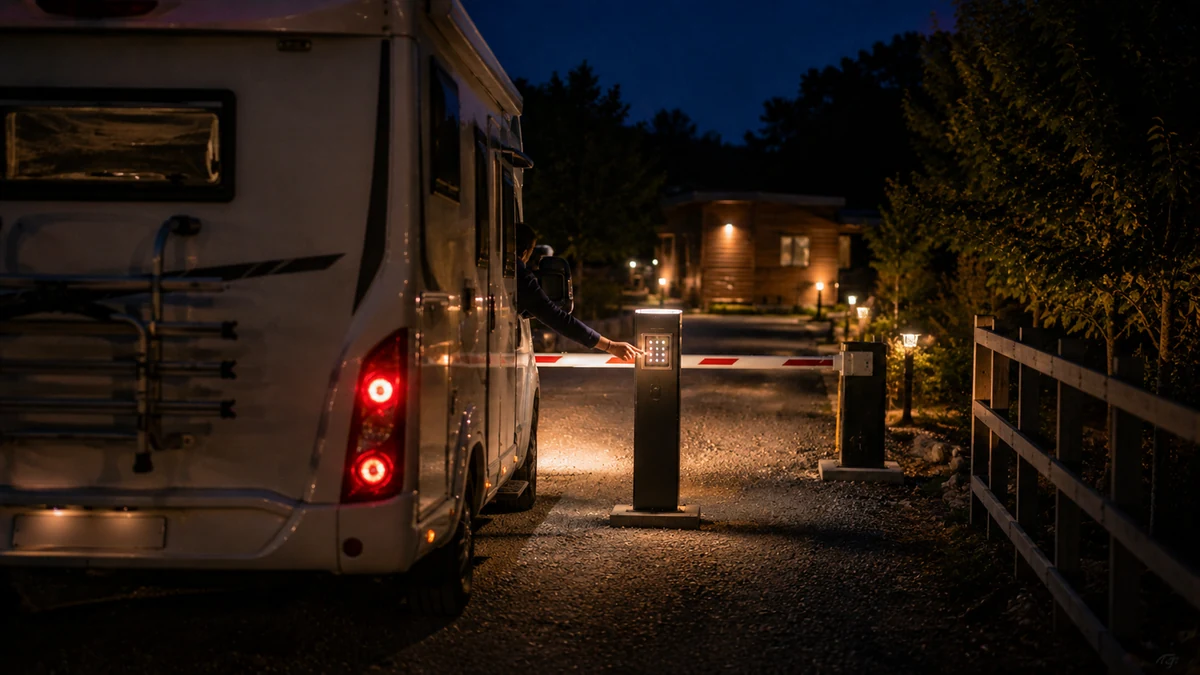
A traveller who has booked and paid receives a code. The barrier opens on their arrival during the booked period, and they can leave at any time. A vehicle that has not paid finds no way in. The entry terminal shows where to enter the code and who to call.
The question to ask
“Show me the barrier opening for a paid booking, then refusing a code whose period has ended.” Also ask about a vehicle that leaves for an hour and comes back.
The common pitfall
Buying the barrier and the software separately, then discovering that they don’t talk to each other. Opening ends up on a remote control, bookings in a spreadsheet, and nothing matches up.
Payment on arrival, even at 23:00, with no appointment
Arrivals at an aire are concentrated at the end of the day. The software must collect payment at that time, on the traveller’s phone, without any detours.
The need
A motorhomer who turns up without a booking reads a sign at the entrance, opens the aire’s public page, chooses how long to stay, pays by card and receives a code. The whole process takes a few minutes, even at 23:00, with no appointment. For a municipality, payment collection operates within a public revenue account; the collecting hire payments through a revenue account page describes this process.
The question to ask
“Have me book and pay from my phone, right now, like a traveller arriving at night.” Time it, and test a declined card.
The common pitfall
Keeping a coin-operated pay machine “as a backup”. It becomes the main route for those who don’t want to book, the cash box fills up with coins to count, and the visitor history is split in two.

Length of stay and extensions
A council aire often limits stays to two or three nights. The software must know this limit, enforce it at booking and make extending as easy as booking the first night.
The need
A maximum stay adjustable for each aire, a price per night or per tier, and an extension the traveller pays for from their pitch as long as the limit has not been reached. At the end of the paid stay, access ends and the dashboard flags the pitch to be vacated.
The question to ask
“A traveller has booked one night and wants to stay a second: what do they do, what do you see, and what happens if they don’t pay?” The answer must describe an online process, not a call to the town hall.
The common pitfall
Not linking the paid duration to access. A vehicle that has paid for one night stays for three, and the next traveller finds the aire full.
Water, electricity, waste disposal: do services follow the booking?
They can, when the service bollard can be controlled. Water and electricity are then switched on for the paid stay and stop when it ends, with no tokens or coins. Compatibility is checked with you, before any commitment.
The need
A stay that includes services or not, according to the municipality’s price list, and a bollard that supplies what has been paid for. Waste water disposal generally remains freely accessible, for public hygiene reasons; fresh water and electricity can be metered.
The question to ask
“My bollard, the one already installed: can it be controlled by the booking? If not, what needs to be added, and at what price?” Ask for an answer for each piece of equipment, priced before ordering.
The common pitfall
Selling a “services included” package on a token-operated bollard. The traveller has paid, the bollard still asks for a token, and the councillor gets the call on a Sunday evening.
Seasonality and seasonal prices
Visitor numbers at an aire double or triple in summer. The price set by council resolution can vary by season, by day of the week or by length of stay, provided the software applies it automatically on the set date.
The need
One price list per period – high season, shoulder season, low season – with a switchover date and a price per night. The traveller sees the price of their night before paying. Pricing of local public services is a matter for a council resolution; the software must reproduce the approved price list, not the other way round.
The question to ask
“Switch my summer price list to the winter one, and show me what a traveller sees when booking a night that straddles the switchover.” This case reveals whether the price is calculated night by night or as a flat rate.
The common pitfall
Leaving the price update until the last minute. The first weekend of July sells at March prices.
Municipality or concession holder: who runs it, who collects payment
A council aire can be run directly by the municipality or by the inter-municipal authority, or entrusted to a concession holder under a concession contract. The software adapts to the arrangement chosen.
The need
Under direct management, the municipality configures the system, collects payments through its public revenue account and reads the statistics. Under public service delegation, the concession holder runs the aire at its own risk and is paid from the revenue, and the municipality keeps oversight of visitor numbers and prices. The local authorities portal describes concessions and public service delegation.
The question to ask
“Can you give the municipality read access to bookings and revenue, and the concession holder operational access?” Rights must be set person by person, with a log of actions.
The common pitfall
Letting the concession holder choose the tool alone, and ending up with no access to the data at the end of the contract. Five years of statistics leave with it.
Public revenue account and online payment
A public revenue account (régie de recettes) is the framework that authorises a municipal officer to collect money on behalf of the Treasury accountant. Without one, a municipality cannot directly collect payment for overnight stays at its aire.
The need
Online payment collection within the revenue account, compliant with the requirements that apply to public revenue accounts. Each payment produces a payment receipt for the traveller and a line for the Public Treasury, with a periodic export for the revenue officer. The fact sheets on advance and revenue accounts detail this framework.
The question to ask
“What document do you give the revenue officer at the end of the month, and in what form?” Have your Treasury accountant read the export before signing.
The common pitfall
Creating the revenue account after setup. The establishing instrument, the appointment of the revenue officer and opening online payment collection with the Public Treasury take weeks; without them, the aire takes bookings but cannot collect payment.
Signage, rules and overnight parking
What the traveller reads at the entrance decides whether they book or park in the car park next door.
The need
A sign at the entrance with the price, the maximum stay, the address of the booking page and a contact number. Rules displayed and repeated at booking: length of stay, no camping outside the pitches, quiet hours, waste. The mayor can regulate motorhome parking on public roads by municipal order; the aire’s signage must refer to it. The motorhome aire booking page shows what the traveller receives.
The question to ask
“Can the aire’s rules be accepted at booking, and found again on the confirmation?” A traveller who has read them and ticked the box can no longer say they didn’t know.
The common pitfall
A sign that says “payment at the town hall during opening hours”. At 23:00, it tells the traveller the night will be free.
Visitor statistics
An aire produces data that few municipalities make use of: overnight stays per month, occupancy rate, share of arrivals after 20:00, revenue per season. These figures justify an extension, a price increase or a grant application.
The need
A dashboard readable from a browser, real-time occupancy, and an export by period for the municipal council. The history must remain the property of the municipality, even under public service delegation. The motorhome aires: booking, payment and access page shows what the manager sees.
The question to ask
“Pull out last August’s overnight stays and revenue, week by week, in two minutes.” If the answer involves a request to support, the data isn’t really yours.
The common pitfall
Making do with the overall revenue figure. Without the number of overnight stays and arrival times, there is no way of knowing whether the aire is full three nights a year or three months a year.
Do you need motorhome aire booking software that controls the barrier itself?
Yes, as soon as the aire takes visitors outside town hall opening hours. Software that does not control the barrier leaves entry to a separate box, with no link to payment. Access control linked to online booking makes the paid stay the only right to enter. Two routes: native control, or an integrator between two systems.
The cost
With native control, access is part of the subscription, from €59 excl. VAT per month, no commitment and no commission; the ASLOT pricing page sets out the principle. On top of that, quoted separately and sent to you before you order: hardware if the aire has none. Via an integrator, expect one more contract and a gateway to maintain.
The lead time
Insist on a setup date for the barrier, before the season. An integrator depends on two schedules; a vendor that handles setup itself has only one.
The contacts
On a Saturday in August at 22:00, the barrier won’t open: who do you call? With two providers, each can pass the buck to the other. Write down the support number and hours before signing.
Faults
Network or power outage: ask what lets people in and how the traveller is notified. A backup code and an exit that is always open are the minimum; the comparison of booking only versus booking with access details both scenarios.
Method: choosing in 5 steps
The method comes down to five steps, from the inventory of the aire to the first measured season.

Checklist: 12 questions to ask during a demo
These twelve questions cover the nine points of the guide and access control. Write down the exact answer.
Choosing motorhome aire booking software in 5 steps
- Take stock of the aire and its equipment
Pitches, barriers, service bollard, electricity supply, network coverage. Note for each piece of equipment whether it can be controlled.
- Write the price list and the rules
Price per night and per season, services included or not, maximum stay, aire rules. This document becomes the software configuration.
- Prepare the revenue account with the Treasury accountant
Instrument establishing the public revenue account (régie), or an amendment to it, appointment of the revenue officer, opening of online payment collection with the Public Treasury. To be started alongside the demo.
- Run a full scenario during the demo
Booking from a phone at the aire entrance, payment, code, barrier opening, extending by one night, end of the stay.
- Get a quote in two parts, then measure one season
The subscription on one side, the hardware and installation on the other, with the setup date. Then one season measured: overnight stays, arrival times, incidents.
12 questions to ask during a demo
- Does the barrier open for a paid booking, and does it refuse a code whose period has ended?
- Can a traveller arriving at 23:00 without a booking book, pay and get in from their phone?
- Is the maximum stay enforced at booking, and can extensions be paid for online?
- Can my current service bollard be controlled by the booking? If not, at what price?
- Can my seasonal price list be reproduced exactly, including a night that straddles two periods?
- Can the municipality read the data while the concession holder runs the aire?
- Does payment collection go through the public revenue account, and what export does the revenue officer receive?
- Can the aire’s rules be accepted at booking and found again on the confirmation?
- Can you pull out the overnight stays and revenue for a given month, week by week?
- Is access control native or does it go through an integrator? Who do we call on a Saturday evening?
- What happens in a network or power outage for a traveller who has paid?
- Does the quote separate subscription, hardware and installation, with a setup date?
Your questions
How can a municipality collect payment for overnight stays at its motorhome aire?
Through a public revenue account (régie), created by decision of the local executive after consulting the Treasury accountant. Online payment operates within this revenue account, in line with the requirements that apply to public revenue accounts. The software produces a payment receipt for the traveller and an export for the revenue officer, who pays the takings over to the Treasury accountant.
What software for a small council aire with six pitches?
The same as for a large one, if the price does not depend on the number of overnight stays. Look first at barrier control and payment on arrival: these two points make up the revenue of a small aire. A no-commitment subscription lets you measure one season before extending to a second aire.
Do you need to replace the barrier or bollard already installed?
Not necessarily. Compatibility is checked with you, piece by piece, before any commitment. A barrier or bollard that can be controlled is connected; a token-operated bollard that cannot be controlled stays separate or is replaced, and this hardware is quoted separately and sent to you before you order. Replacement is the exception, not the rule.
How do you handle a motorhome that turns up at 23:00 without a booking?
The motorhomer reads the sign at the entrance, opens the aire’s public page on their phone, chooses how long to stay, pays and receives a code. The barrier opens for the paid period, including at 23:00, with no appointment. The municipality sees the stay on its dashboard and the revenue in the revenue account export.
What happens if a vehicle stays beyond its booked stay?
Their code no longer opens the barrier at the entrance, the exit stays open, and the dashboard flags the pitch. The traveller can extend online as long as the aire’s maximum stay has not been reached. Beyond that, the aire’s rules and the municipal order apply, with the time-stamped access history as evidence.
Can the concession holder and the municipality use the same software?
Yes, with different rights. The concession holder runs the aire: prices, bookings, incidents. The municipality consults: occupancy, overnight stays, revenue. Rights are set person by person and every action is logged. At the end of the contract, the history remains accessible to the municipality, so it does not have to start from scratch for the next tender.
How much does motorhome aire management software cost for a municipality?
ASLOT starts at €59 excl. VAT per month, with no commitment and no commission on payments. The exact price is set during the demo, based on your actual pitches and equipment. Access control hardware, if needed, is quoted separately and sent to you before you order.
Official references
Read next
See ASLOT applied to your case
Thirty minutes, no commitment, to check what the platform changes for your spaces and equipment.